
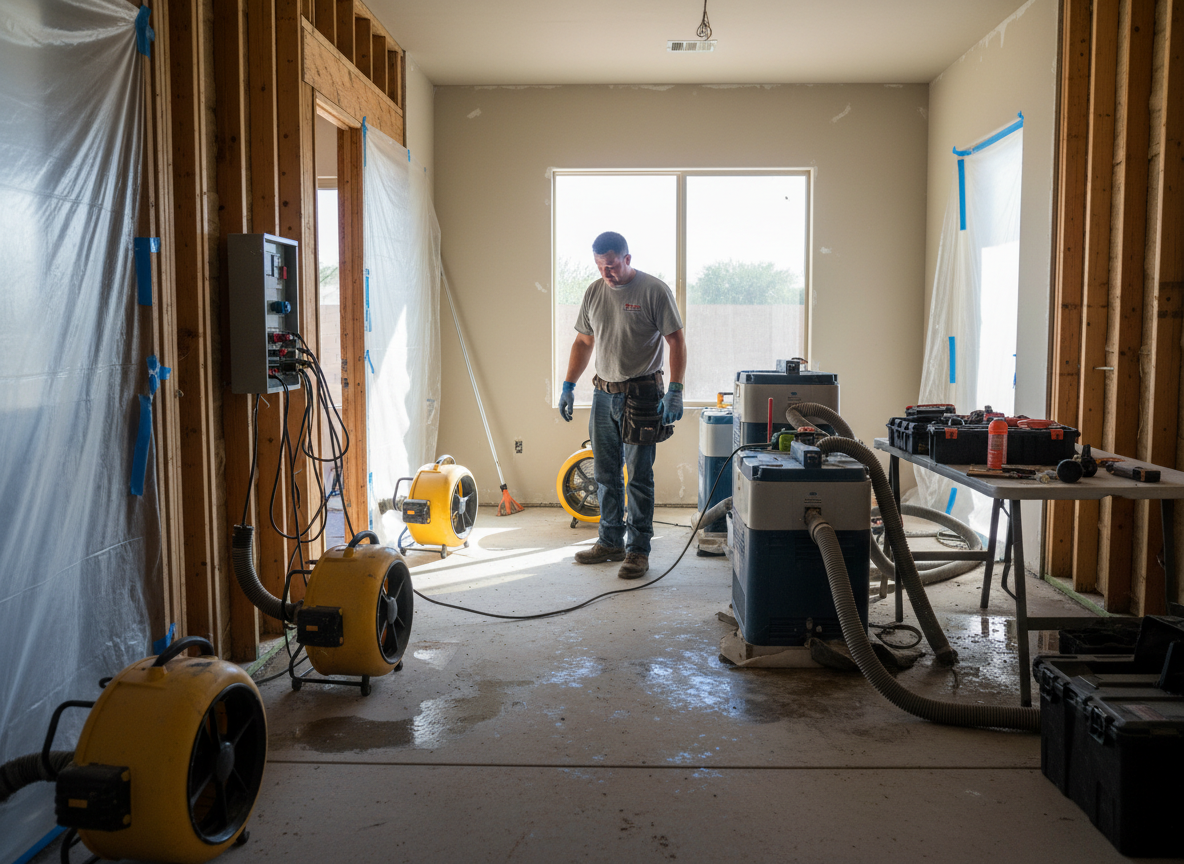
Goodyear’s hot desert summers push surface moisture out quickly while trapping vapor inside stucco-clad walls and slab foundations common in Palm Valley and Canyon Trails. Technicians place air movers and dehumidifiers to create negative pressure gradients that pull hidden water from drywall and subfloors without forcing it deeper into insulation. In Estrella homes built on expansive soil, even small leaks can migrate under tile, so moisture meters are used daily to confirm readings below 12 percent before equipment is removed.
Mild winters in Maricopa County still allow condensation inside poorly vented attics when cooler nights follow warm days, especially near Estrella Mountain Regional Park. Technicians often find that standard household fans fail to lower relative humidity below 50 percent, allowing mold to start on ceiling joists within 48 hours. Industrial desiccant units are brought in for these cases because they maintain consistent drying regardless of outdoor temperature swings between Phoenix and Avondale.
Homes in Goodyear Village and Peoria Crossing frequently have older plumbing runs that leak behind cabinets or under vanities. Once water reaches the slab, capillary action pulls it several feet outward, so drying requires drilling small weep holes and inserting flex ducting rather than relying on surface evaporation alone. Continuous data logging tracks temperature and humidity every four hours to satisfy insurance documentation requirements for claims filed from Tolleson residents.
Flash flooding along washes near Goodyear Ballpark can push water into crawl spaces that lack vapor barriers. In these situations, structural drying includes removing saturated insulation, treating wood framing with antimicrobial solutions, and running high-grain dehumidifiers for five to seven days until equilibrium moisture content is reached. Skipping the final verification step often leads to callbacks when humidity rebounds after monsoon season.
Technician insight
In Goodyear, the thing that catches most people out with Structural Drying & Dehumidification is how quickly our summer heat bakes the outer stucco while leaving pockets of moisture behind the paper-faced drywall in Palm Valley tract homes; if you stop too soon the humidity rebounds once the monsoons hit.
Canyon Trails Slab Leak
Water from a supply line under tile migrated into the slab and subfloor of a 2008 home. Mapping showed elevated readings extending four feet into the adjacent hallway. Technicians drilled weep holes, ran negative-pressure drying for six days, and confirmed dry readings before reinstalling baseboards.
Structural Drying & Dehumidification Services We Offer
✓Wall Cavity Drying
Small access points and negative-pressure drying pull moisture from inside stucco and drywall assemblies common in Palm Valley homes.
✓Subfloor Moisture Extraction
Targeted removal of water trapped between slab and flooring in Estrella and Canyon Trails properties before mold develops.
✓Attic and Ceiling Drying
Desiccant dehumidification lowers humidity in vented and unvented attics after roof leaks or condensation events.
✓Crawl Space Structural Drying
Equipment placement and vapor barrier drying for homes near washes that experience seasonal water intrusion.
✓Post-Flood Cabinet and Vanity Drying
Weep-hole drilling and directed airflow to dry behind built-ins without full demolition in older Goodyear Village residences.
Structural Drying & Dehumidification Cost in Goodyear, AZ
| Service | Typical Range | What Affects It |
|---|---|---|
| Single-room drying | $650–$1,200 | Higher in summer due to faster equipment cycling needed |
| Whole-home drying after slab leak | $2,400–$4,800 | Driven by crawl space access and soil moisture content |
| Attic drying only | $900–$1,600 | Varies with insulation type and roof pitch |
| Daily equipment rental extension | $175–$325 | Per additional day after initial three-day minimum |
Ranges are typical for Goodyear, AZ and confirmed with an exact written quote before any work starts.
How it works
- 1
Moisture Mapping
Technicians use meters and thermal imaging to locate hidden water across affected rooms and adjacent spaces.
- 2
Water Extraction
Standing water is removed first with pumps and wands before drying equipment is positioned.
- 3
Equipment Setup
Air movers, dehumidifiers and flex ducting are placed to create directed airflow through cavities and under floors.
- 4
Daily Monitoring
Readings are logged every four hours and equipment is adjusted until moisture levels stabilize.
- 5
Final Verification
Independent meter checks confirm all materials are dry before equipment removal and site cleanup.
Pricing
Pricing depends on square footage affected, number of rooms, and days of equipment runtime required by seasonal heat.